
TL;DR:
- Compostable bags must be processed in industrial composting facilities to provide environmental benefits.
- Many UK facilities do not accept compostable bags, risking them ending up in landfills.
- Proper certification, clear labelling, and infrastructure checks are essential for effective compostable packaging use.
Switching to compostable bags sounds like a simple win for your business and the planet. But for UK food service operators, the reality is far more complicated. Many businesses make the switch believing their packaging will break down harmlessly, only to discover that certified compostable packaging must enter specific waste streams to deliver any environmental benefit at all. This guide cuts through the confusion, covering what compostable bags actually are, which certifications matter, how the UK’s composting infrastructure works in practice, and what you need to do to stay compliant and avoid greenwashing claims.
| Point | Details |
|---|---|
| Understand compostable claims | Not all compostable bags are the same—look for clear certification and correct product labelling. |
| Infrastructure limits matter | Few UK facilities process compostable bags, so always check local acceptance before switching. |
| Performance is proven but context-specific | Certified compostable bags work well in industrial settings but need proper disposal systems to deliver environmental benefits. |
| Avoid greenwashing | Accurate claims and customer communication are vital to stay compliant and build trust. |
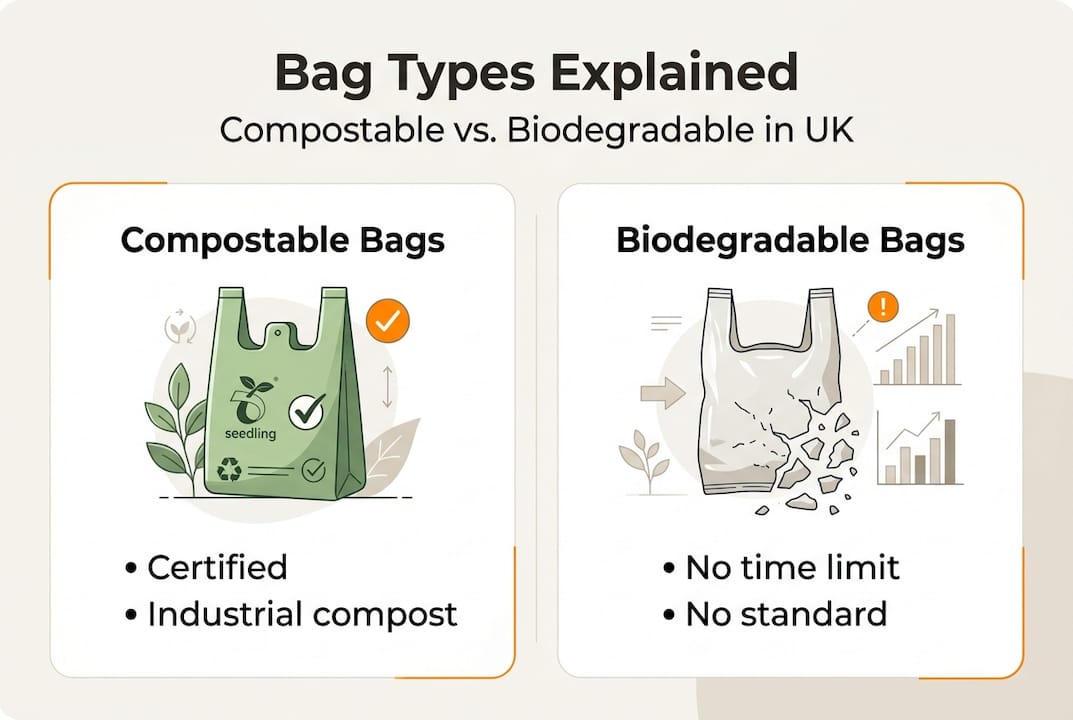
A compostable bag is not simply a bag that breaks down over time. In the UK regulatory context, a compostable bag is one that degrades under specific controlled conditions, producing compost, water, and carbon dioxide without leaving harmful residues. That definition matters enormously, because it separates compostable products from two terms that are frequently confused with them.
Biodegradable means a material breaks down biologically, but there is no time limit, no standard for what it leaves behind, and no requirement for a specific environment. A plastic bag labelled biodegradable might take decades and still leave microplastic fragments. Recyclable packaging, by contrast, is designed to re-enter a material stream and become a new product. You can explore the differences further in this recyclable packaging guide for UK food businesses.
Compostable bags must meet defined standards. The two most relevant in the UK are:
| Standard | What it covers | Context |
|---|---|---|
| EN 13432 | Industrial composting of packaging | Required for most commercial claims |
| PAS 100 | Quality protocol for compost outputs | Relevant to composting facilities |
| OK Compost HOME | Home composting at lower temperatures | Separate certification, stricter |
This distinction between industrial and home compostable is critical. Industrial composting takes place at temperatures above 55°C in controlled facilities. Home composting happens at ambient temperatures in a garden bin. Most compostable bags on the market are industrial only, meaning they will not break down in your home compost bin within any reasonable timeframe. The ASA has issued rulings confirming that marketing must clearly specify which type applies, and implying home compostability for an industrial-only product is misleading.
Common materials used in compostable food service bags include:
If you are evaluating your full packaging range, our overview of eco-friendly packaging options covers the broader landscape for food businesses.
Understanding what compostable bags are sets the stage for grasping their importance and growing popularity in the UK food sector. Two regulatory forces are accelerating adoption right now. The single-use plastics (SUP) bans have already removed many conventional plastic bags from the food service environment. Extended producer responsibility (EPR) fees, which charge businesses based on the environmental impact of their packaging, are creating a direct financial incentive to switch to lower-impact materials.
The numbers reflect this shift. The UK compostable
food-service packaging market is valued at USD 2.32 billion in 2026, projected to reach USD 3.69 billion by 2036 at a 4.7% CAGR, driven by SUP bans and EPR modulated fees.
“The UK compostable
food-service
packaging market is set to nearly double in a decade, reaching USD 3.69 billion by 2036 as regulatory pressure and consumer expectations converge.”
| Year | Market value (USD) | Growth driver |
|---|---|---|
| 2026 | 2.32 billion | SUP bans, EPR fees |
| 2030 | ~2.85 billion | Consumer demand, regulation |
| 2036 | 3.69 billion | Full EPR rollout, retail pressure |
For food service businesses, the benefits of adopting compostable bags go beyond compliance. Customers are actively choosing where to spend money based on packaging choices. Partnering with suppliers who share environmental commitments, much like this sustainable coffee wholesaler demonstrates, signals credibility to eco-conscious consumers.

Compostable bags also support branding opportunities. Printed compostable bags carry your logo while communicating your values. For businesses looking to act on this, our range of eco-friendly food service disposables includes certified options suited to food service environments. Thinking carefully about reducing packaging waste across your operation can compound these benefits further.
The increasing demand for compostable bags makes it vital to assess where these products actually go after use. The honest answer is: often not where you expect.
Here is the typical waste journey for a compostable bag in a UK food service setting:
The problem is stark. Only around 27 UK facilities currently accept compostable packaging, and many councils actively reject compostable bags from food waste collections because their AD or IVC systems cannot process them correctly. Anaerobic digestion, which is the most common food waste processing method in the UK, does not compost materials. It digests organic matter to produce biogas and digestate. Compostable bags can disrupt this process and are often screened out before they even enter the digester.
This means a bag certified to EN 13432 can still end up in landfill simply because the local infrastructure cannot handle it. For guidance on thinking through your full waste approach, our article on packaging waste reduction is a practical starting point, and our resource on sustainable catering packaging covers broader options.
Pro Tip: Before committing to compostable bags, contact your waste contractor directly and ask whether your local facility accepts EN 13432 certified packaging in the food waste stream. If they do not, consider whether a different sustainable material might deliver better real-world outcomes for your business.
Knowing the operational realities, the next question is how compostable bags actually perform and how businesses can meet both quality and compliance standards.
The evidence from controlled trials is encouraging. Full-scale composting trials by Envar show that certified compostable packaging degrades steadily in industrial composting conditions, meets PAS 100 quality standards, and produces no measurable microplastic impact. This is a meaningful distinction from conventional plastic, which fragments into microplastics throughout its degradation. When the infrastructure works correctly, certified compostable bags do what they claim.
PAS 100 is the UK quality protocol for compost. It sets limits on contamination, heavy metals, and physical impurities in finished compost. When compostable packaging meets this standard, composting facilities can sell the resulting compost commercially. That creates a genuine circular outcome.
For compliance and advertising, the rules are clear. The ASA requires that any claim specifies whether a product is home or industrially compostable. Vague claims like “eco-friendly” or “breaks down naturally” without qualification risk enforcement action.
When choosing compostable bags for your food service operation, check for:
For a broader view of how materials compare, our UK packaging materials guide covers performance characteristics across categories. And if you want to communicate your sustainability credentials effectively, our packaging design tips can help you do so without crossing into greenwashing territory.
Pro Tip: Train your front-of-house team to explain your packaging choices accurately to customers. Saying “this bag is industrially compostable and should go in your food waste bin if your council accepts it” is far more credible than a vague claim, and it protects you from ASA scrutiny.
After examining the practical and compliance landscape, it is worth being frank about where compostable solutions really stand.
We see a pattern repeat itself constantly in food service: a business switches to compostable bags, adds a green leaf logo to their branding, and considers the sustainability problem solved. But if those bags are going into general waste because the local council rejects them, the environmental outcome is no better than conventional plastic. Possibly worse, given the energy used to manufacture bioplastics.
This is sometimes called “wishcycling” or, more bluntly, greenwashing. The intention is good. The outcome is not. The gap between marketing promise and waste system reality is where most compostable bag strategies fall apart.
The businesses that genuinely benefit from compostable packaging are those that treat it as part of a system. They verify local infrastructure. They train staff. They communicate honestly with customers. They review their entire packaging range, not just swap one product. Our resource on broader sustainable disposables reflects this systems approach.
Single-product swaps feel satisfying but rarely deliver the impact businesses hope for. Sustainable packaging is a continuous process, not a destination.
For food businesses looking to act on these insights, reliable partners can ease the path to compliant, effective sustainability.

At Grab & Go Packaging, we stock certified compostable and sustainable packaging options designed specifically for UK food service environments. Whether you need bags, containers, or disposables that meet EN 13432 standards, our range is built around what actually works in practice. Our food packaging materials guide helps you compare options before you buy, and our sustainable disposables range covers everything from certified compostable bags to bagasse containers. We work with businesses of all sizes across the UK, helping you make packaging decisions that hold up to both regulatory scrutiny and customer expectations.
No. Only around 27 UK facilities currently accept compostable packaging, and most councils reject them due to AD processing limitations. Always check with your local waste contractor before making claims about compostability.
Bags should carry EN 13432 or meet PAS 100 standards to qualify for UK industrial composting. Look for the certification mark printed clearly on the product.
Most do not. The majority of compostable bags require industrial composting at high temperatures. ASA rules require clear labelling distinguishing between home and industrial compostable products.
They can be, but only when processed correctly. Full-scale trials confirm certified compostables degrade without microplastic impact in industrial composting. Poor disposal removes this benefit entirely.
food-service