
PP plastic accounts for 35% of global packaging demand, yet it remains one of the most misunderstood materials in the food service industry. Walk into any busy café, takeaway, or catering kitchen and you will find PP containers, lids, and tubs doing quiet, essential work. But ask most operators whether their PP packaging is food safe, recyclable, or compliant with 2026 UK regulations and you will often get a blank stare. This guide cuts through the confusion. We will cover what PP plastic actually is, how its different grades perform in real food service settings, what the regulations mean for your business, and how to make smarter, more sustainable packaging choices.
| Point | Details |
|---|---|
| PP is versatile and safe | Polypropylene (PP) is durable, heat resistant, and approved for a wide range of food packaging uses. |
| Recycling challenges remain | Although recyclable, UK PP food packaging rates are just 1–3% due to current collection and sorting barriers. |
| Sustainability is improving | Emerging food-grade recycled PP and smarter design can cut carbon footprint by up to 70% compared to virgin material. |
| UK regulations drive change | Taxes and EPR fees in the UK incentivise recycled content and recyclable PP packaging for food businesses. |
| Best practice maximises value | Using mono-material, food-grade recycled PP and monitoring compliance ensure safe, cost-effective, and sustainable packaging. |
Polypropylene, or PP, is a thermoplastic polymer that has become a cornerstone of modern food packaging. It is produced from propylene gas, a by-product of oil and gas refining. At a molecular level, PP is a semi-crystalline thermoplastic derived from propylene monomers using Ziegler-Natta or metallocene catalysis. That might sound technical, but what it means in practice is that PP can be engineered to be rigid or flexible, clear or opaque, depending on how it is processed.
For food businesses, the material properties are what really matter. PP is lightweight, which keeps your packaging costs and delivery weights down. It is highly durable, resisting cracking and impact during transit. Crucially, PP’s density, melting point, and chemical resistance make it one of the safest plastics for direct food contact. It absorbs almost no moisture, which means it will not degrade or leach when holding soups, sauces, or chilled foods.
PP plastic can withstand temperatures from around minus 20°C up to 150°C, making it suitable for freezer storage, hot food service, and microwave reheating in a single container.
If you are exploring the full range of materials available to your operation, it is worth reviewing the types of catering packaging to understand where PP fits alongside alternatives like PET, CPET, and bagasse.
Key properties of PP plastic at a glance:
Not all PP is the same. There are three main grades used in food packaging, each with distinct performance characteristics.
| PP grade | Key properties | Typical food packaging uses |
|---|---|---|
| Homopolymer | Rigid, high clarity, stiff | Lids, tubs, deli containers |
| Random copolymer | Improved clarity, flexible | Microwave bowls, yoghurt pots |
| Impact copolymer | Toughest, less clear | Takeaway containers, bulk tubs |
Common grades for food packaging each serve a specific purpose. Homopolymer PP is the workhorse for rigid, transparent lids and deli tubs. Random copolymer PP offers better clarity and flexibility, making it ideal for microwave-safe bowls. Impact copolymer PP sacrifices some clarity for superior toughness, which is why it is used for takeaway containers that need to survive a delivery journey.
Understanding which grade suits your menu is a practical step. A business serving hot curries needs impact copolymer containers that will not warp. A patisserie displaying cold desserts benefits from the crystal clarity of random copolymer tubs. Reviewing food packaging best practices can help you match the right grade to each product line.
Pro Tip: When choosing disposable containers, always check whether the lid and base are the same PP grade. Mixing grades can complicate recycling and may affect the seal integrity under temperature changes.
Why PP dominates food packaging:
Food safety is non-negotiable. The good news is that PP has one of the strongest safety records of any food contact plastic. Here is what you need to know.
For a full overview of how PP fits within the broader landscape of compliant materials, the food packaging regulations guide is an essential reference. Understanding the packaging impact on food service operations can also help you make more informed procurement decisions.
This is where the picture gets more complicated. PP is technically recyclable, but the reality for UK food businesses is more nuanced.
| Factor | Current reality | Future potential |
|---|---|---|
| UK post-consumer recycling rate | 1 to 3% | 20%+ with improved sorting |
| Carbon footprint vs virgin PP | Baseline | 70% lower with rPP |
| Food-grade recycled PP availability | Very limited | Growing via NextLooPP/WRAP |
| Sorting infrastructure | Inconsistent by council | Improving under EPR reforms |
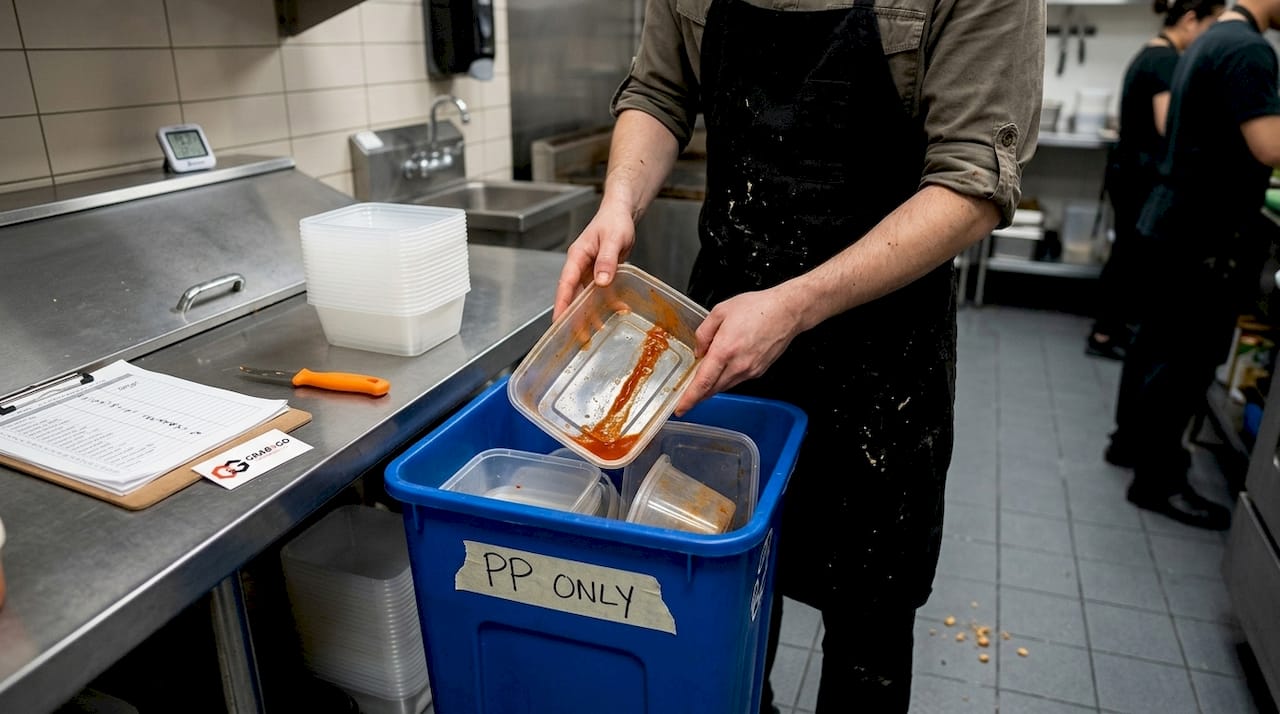
The UK PP recycling rate of 1 to 3% is low primarily because of contamination from food residue and the difficulty sorting PP from other plastics at materials recovery facilities. Projects like NextLooPP and WRAP protocols are actively working to change this, demonstrating that clear and white PP food containers have up to 90% food-grade recycled potential when properly sorted.
Switching to recycled PP is not just an environmental choice. Recycled PP delivers 70% lower carbon emissions than virgin PP, often outperforming glass and aluminium on lifecycle climate impact for single-use containers.
Pro Tip: When reviewing your sustainable packaging tips, prioritise mono-material PP designs. A container and lid both made from the same PP grade are far easier to recycle than mixed-material alternatives. This also improves your score under emerging recyclability assessment frameworks.
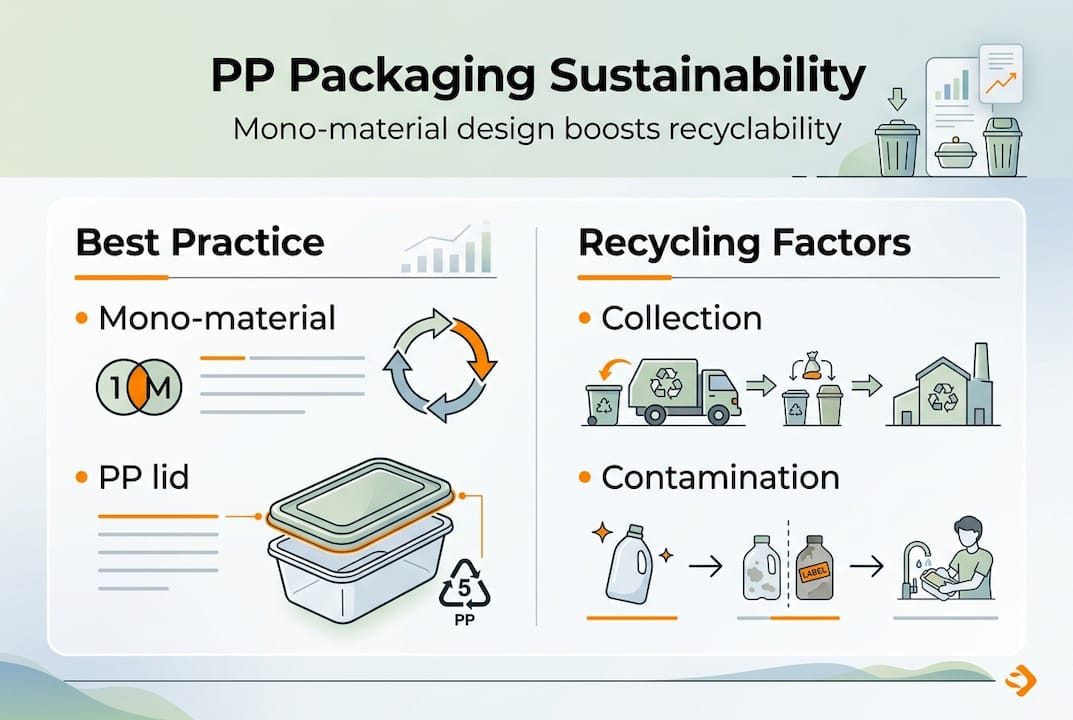
For a deeper look at what qualifies as genuinely recyclable, the recyclable packaging guide is a practical starting point. If you are redesigning your packaging range, packaging design for recyclability offers actionable guidance on material choices and label placement that can affect recyclability scores.
The regulatory environment for plastic packaging in the UK has shifted significantly and will continue to evolve through 2026 and beyond.
What you need to know right now:
Staying current with UK food packaging rules is not optional. The financial penalties for non-compliance and the cost savings from proactive design choices make this a business-critical area. The recyclable packaging regulations guide breaks down the RAM scoring system in plain language.
Knowing the theory is one thing. Here is how to put it into practice in your operation.
For a practical overview of what to stock and how to manage your packaging range efficiently, the essential catering packaging guide covers the fundamentals for SME food businesses.
At Grab N Go Packaging, we stock a carefully selected range of food-grade PP containers, tubs, lids, and microwave-safe bowls that meet UK compliance standards. Every product in our range is tested for food contact safety, and we are actively expanding our recycled PP options as supply becomes available.

If you are ready to review your current packaging setup, our UK food packaging guide is a free resource that covers material choices, regulatory requirements, and sustainability benchmarks in one place. When you are ready to order, browse our full packaging range to find compliant, competitively priced PP solutions that work for your menu, your budget, and your sustainability goals. We make it straightforward to source the right packaging without the guesswork.
Yes, food-grade PP plastic is heat resistant up to 150°C and is approved for direct contact with hot foods and microwave reheating, provided the container carries the appropriate food-contact certification.
PP packaging is technically recyclable, but UK recycling rates remain at 1 to 3% due to contamination and sorting limitations. Choosing clear or white mono-material PP significantly improves the chances of your packaging being recycled.
Recycled PP generates 70% less carbon than virgin PP and frequently outperforms glass and aluminium on lifecycle climate impact, making it a strong choice when recycled content is available.
The Plastic Packaging Tax at £223 per tonne applies to packaging with less than 30% recycled content, while EPR fees incentivise recyclable designs. Both create direct financial reasons to upgrade your packaging choices.
Opt for mono-material, clear or white PP and avoid black pigments or mixed-material components. Mono-material clear PP has up to 90% food-grade recycled potential when correctly sorted, making it the most recyclable format currently available.