
Many restaurant owners believe all cardboard packaging performs equally, yet choosing the wrong box type costs UK food businesses thousands in damaged deliveries and lost customers annually. Corrugated boxes offer a scientifically engineered solution combining strength, sustainability, and food safety that standard cardboard simply cannot match. This guide explains what corrugated boxes are, how their unique structure protects your food during delivery, and practical tips for selecting the right specifications to reduce costs whilst maintaining quality standards your customers expect.
| Point | Details |
|---|---|
| Box structure matters | The layered fluted core provides strength cushioning and protection during delivery, making corrugated boxes superior to standard cardboard. |
| Flute types vary | A to F flute profiles determine cushioning and rigidity and thus suitability for different foods. |
| Sustainability and recyclability | Corrugated boxes are recyclable and commonly contain recycled content, supporting a circular economy in UK food packaging. |
| Testing before orders advised | Request samples of different wall configurations and test them with real food products under delivery conditions to verify protection. |
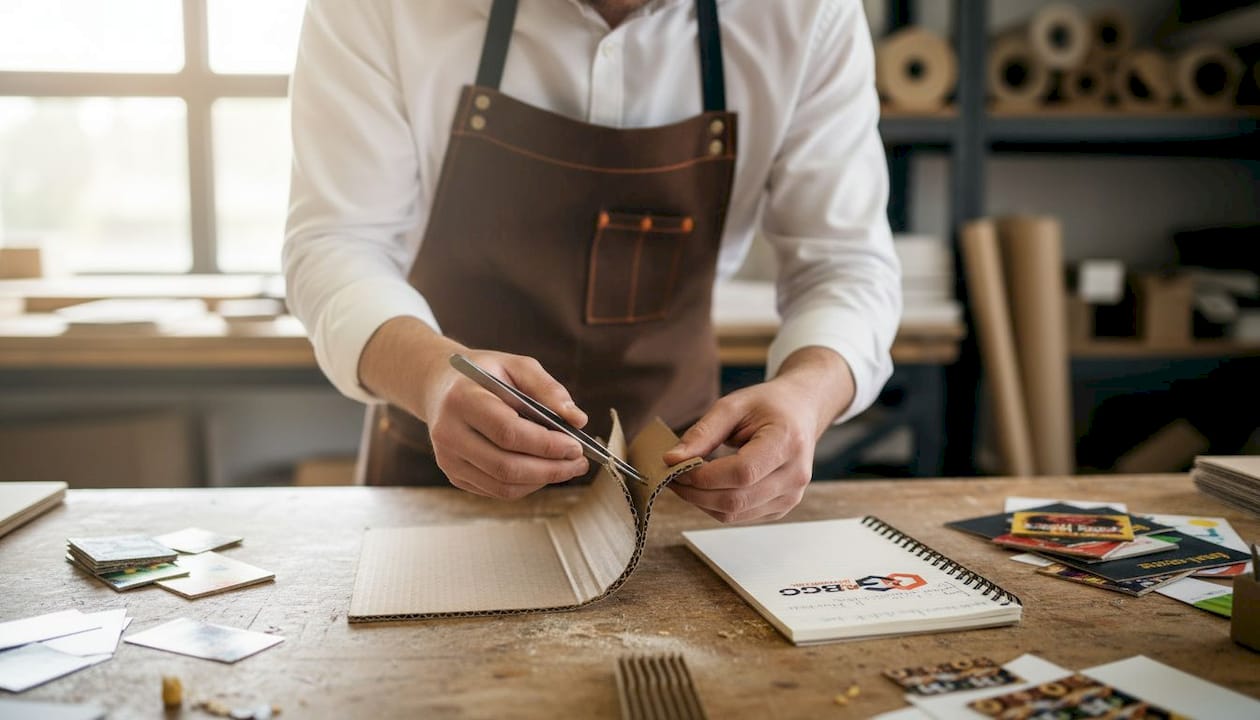
Corrugated boxes are multi-layered containers with a fluted middle layer between linerboards providing strength and cushioning. This wavy inner layer acts like a shock absorber, distributing impact forces across the box structure rather than concentrating pressure at single points. The outer linerboards provide smooth surfaces for printing and handling whilst protecting the delicate flutes from damage.
The construction process starts with paper-based fibreboard sheets fed through corrugating machines that heat and shape the middle layer into distinctive wave patterns. Adhesive bonds these fluted sheets between flat linerboards, creating a rigid yet lightweight composite material. Single-wall boxes use one fluted layer, double-wall incorporates two fluted layers for heavier loads, and triple-wall construction handles industrial shipping requirements.
This paper-based composition makes corrugated boxes inherently recyclable and biodegradable, addressing growing environmental concerns amongst UK consumers. The materials break down naturally without leaving microplastics or persistent pollutants in landfills. Most manufacturers now incorporate substantial recycled content into new boxes, creating a circular economy that reduces virgin material demand.
Understanding this structural design helps you recognise why corrugated packaging delivers value beyond simple containment. The engineering behind corrugated boxes transforms basic paper into a protective system capable of withstanding the rigours of commercial food delivery. Different flute patterns and wall configurations allow manufacturers to optimise boxes for specific applications, from delicate pastries to heavy catering trays.
Pro Tip: Request samples of different wall configurations before committing to large orders. Test them with your actual food products under realistic delivery conditions to verify they meet your specific protection requirements.
Key structural advantages include:
Flute types vary from A to F with thickness and cushioning affecting use cases, with E-flute proving best for printed pizza boxes. Each flute profile creates different performance characteristics that directly impact how well your packaging protects food during handling and transport. A-flute measures approximately 5mm thick and provides maximum cushioning for fragile items, making it ideal for delicate pastries or decorated cakes that cannot tolerate compression.
B-flute offers moderate rigidity at 3mm thickness, balancing protection with space efficiency for stacked storage. C-flute represents the most common choice at 4mm, delivering versatile performance across general food packaging applications. E-flute reduces thickness to 1.5mm whilst maintaining adequate strength, creating smooth surfaces that showcase high-quality printing for branded pizza boxes and premium takeaway presentations. F-flute, the thinnest option at 0.8mm, suits lightweight items where appearance matters more than heavy-duty protection.
Strength metrics like ECT, Burst, and BCT determine box performance under pressure and stacking in transit. Edge Crush Test (ECT) measures how much force the corrugated board withstands when pressure applies perpendicular to the flute direction, directly correlating to stacking strength. Values range from 23 ECT for light applications to 71 ECT for heavy-duty requirements.
Burst strength tests how much pressure the box surface tolerates before puncturing, critical for protecting against sharp objects during handling. Box Compression Test (BCT) predicts the maximum weight a box supports when stacked, essential for calculating safe storage heights in delivery vehicles and warehouse environments. McKee’s formula estimates BCT by multiplying ECT by box perimeter and a constant derived from box dimensions, helping you predict real-world stacking capacity.
Selecting appropriate specifications requires matching box strength to your operational demands. Essential takeaway boxes for standard meals typically need 32-44 ECT ratings, whilst heavy catering orders demand 51-71 ECT to prevent collapse during transport. Consider the weight of your filled containers, typical stacking heights in delivery bags, and handling conditions your boxes encounter from kitchen to customer doorstep.
| Flute type | Thickness | Best applications | Print quality | Cushioning |
|---|---|---|---|---|
| A-flute | 5mm | Fragile items, cakes, delicate pastries | Fair | Excellent |
| B-flute | 3mm | General containers, moderate stacking | Good | Good |
| C-flute | 4mm | Versatile packaging, standard deliveries | Good | Very good |
| E-flute | 1.5mm | Pizza boxes, branded packaging, retail | Excellent | Adequate |
| F-flute | 0.8mm | Lightweight items, premium presentation | Excellent | Minimal |
Pro Tip: Use McKee’s formula to calculate required BCT before ordering custom boxes. Multiply your planned stacking height by container weight, then add a 40% safety margin to account for humidity and handling variations during delivery operations.
Practical selection considerations:
Grease-resistant coated corrugated boxes with Kit levels 5-12 protect oily and fried foods effectively. The Kit test measures how well coatings repel oil penetration, with higher numbers indicating superior resistance. Burgers and sandwiches typically require Kit levels 5-7, providing adequate protection for moderate grease exposure during typical 20-30 minute delivery windows. Heavily fried items like fish and chips, fried chicken, or tempura demand Kit levels 8-12 to prevent oil seepage that damages box integrity and creates messy customer experiences.
These coatings work by creating a barrier layer that oil cannot penetrate, either through wax applications, polymer films, or newer bio-based alternatives. Traditional wax coatings offer good grease resistance but may affect recyclability, whilst modern aqueous coatings maintain environmental benefits without compromising protection. Verify that coatings are PFAS-free, as these persistent chemicals face increasing regulatory scrutiny and consumer backlash across the UK market.
Vented corrugated boxes address the unique challenge of steam release from hot fried foods. Strategic perforations or designed gaps allow moisture vapour to escape whilst retaining heat, preventing the sogginess that ruins crispy textures customers expect. Chips, fried chicken, and battered fish maintain their appealing crunch when packaging breathes properly, directly impacting customer satisfaction and online review ratings.
Leakproof and insulated corrugated options protect sauces and hot meals during delivery. Some designs incorporate polymer liners that contain liquids without compromising the corrugated structure, ideal for curry boxes, pasta dishes with sauce, or soup containers. Insulated versions use additional corrugated layers or specialised materials to maintain temperature, keeping hot foods above 63°C to meet food safety standards whilst preventing burns from excessive heat.
UK best practices include using food-grade recyclable materials, separate boxes for hot and cold items, and snug designs to reduce movement. Separating temperature zones prevents condensation forming on cold items when packed alongside hot foods, which causes packaging failure and food quality degradation. Snug fits minimise food shifting during transport, reducing spillage and maintaining presentation quality that influences customer perception.
Sustainability represents a growing priority for UK food businesses facing consumer demand for environmental responsibility. Most corrugated boxes contain 80-96% recycled content, dramatically reducing the environmental footprint compared to virgin material packaging. The paper-based composition biodegrades naturally, avoiding the persistent pollution problems associated with plastic alternatives. Many UK councils accept corrugated boxes in standard recycling collections, simplifying waste management for customers and reducing landfill contributions.
Pro Tip: Conduct field tests by filling boxes with your actual menu items, then transporting them in typical delivery conditions for 45 minutes. Check for oil seepage, structural integrity, and temperature retention to verify specifications match real-world performance before committing to large inventory purchases.
Food service specific features:
Corrugated boxes are stronger and more protective than single-layer cardboard, which is weaker and less suited for shipping and stacking. The fundamental structural difference lies in the engineered flute layer that transforms basic paper into a load-bearing composite material. Single-layer cardboard relies solely on paper thickness for strength, making it prone to crushing under modest pressure and puncturing from sharp objects.
This strength advantage translates directly into reduced food damage during delivery operations. Corrugated boxes maintain their shape when stacked in delivery vehicles, preventing the crushing that ruins presentation and causes spillage. The cushioning effect absorbs road vibrations and handling impacts that would otherwise disturb food arrangement or crack delicate components.
Durability differences become apparent under challenging conditions common in food delivery. Corrugated boxes tolerate brief moisture exposure from rain or condensation without immediate structural failure, whilst cardboard rapidly loses integrity when wet. The multi-layer construction distributes stress across the entire structure rather than concentrating forces at weak points, extending useful life through multiple handling stages from kitchen to customer.
Environmental advantages include high recyclability rates of 80%-96% and often being made from mono-materials, unlike many plastics. This mono-material composition simplifies the recycling process, as boxes do not require separation of different material types before processing. UK recycling facilities readily accept corrugated boxes, creating a closed-loop system that reduces virgin material demand and landfill waste.
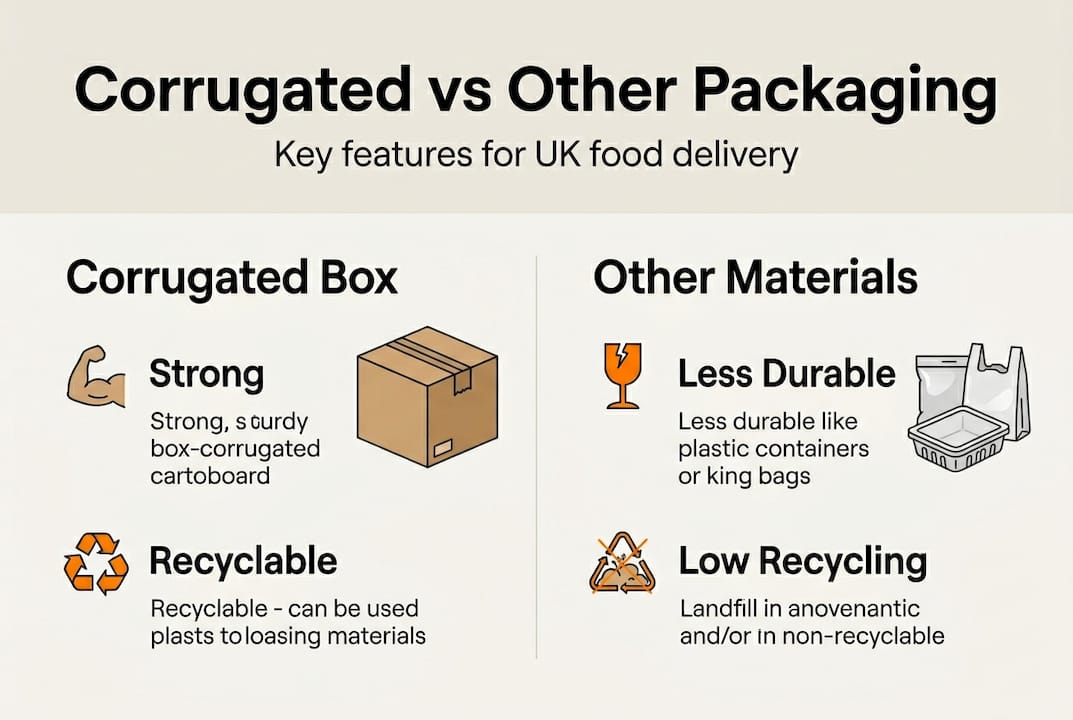
The carbon footprint of corrugated packaging remains significantly lower than plastic alternatives throughout the lifecycle. Paper production and recycling consume less energy than plastic manufacturing, whilst biodegradability ensures corrugated boxes do not persist as environmental pollutants if they escape waste management systems. For UK food businesses targeting environmentally conscious consumers, sustainable corrugated packaging supports marketing messages about corporate responsibility.
Cost considerations favour corrugated boxes for most food delivery applications. Whilst initial unit costs may exceed basic cardboard, the reduction in damaged orders and customer complaints delivers superior return on investment. Damaged deliveries require replacement meals, refunds, and customer service time that quickly exceed any packaging savings. The improved customer experience from intact, properly presented food drives repeat business and positive reviews that attract new customers.
| Feature | Corrugated boxes | Single-layer cardboard | Plastic containers |
|---|---|---|---|
| Strength | Excellent, multi-layer structure | Poor, crushes easily | Variable, depends on thickness |
| Cushioning | Superior flute protection | Minimal impact absorption | None, rigid structure |
| Moisture resistance | Moderate, coating dependent | Poor, fails when wet | Excellent |
| Recyclability | 80-96%, widely accepted | High, but limited reuse | Low, mixed material challenges |
| Food suitability | Excellent with proper coatings | Limited, grease penetration | Good, but environmental concerns |
| Cost efficiency | Best for delivery operations | Lowest unit cost | Moderate to high |
Practical implications for food businesses:
Navigating corrugated box specifications requires expertise that most food business owners lack time to develop. Grab & Go Packaging simplifies this packaging selection process by offering tailored guidance based on your specific menu items, delivery distances, and volume requirements. Their team understands the practical challenges UK food businesses face, from grease resistance for fried foods to ventilation requirements for maintaining crispy textures.

Their product range includes grease-resistant corrugated boxes with appropriate Kit ratings, vented designs for steam release, and insulated options for temperature-sensitive deliveries. Whether you operate a busy takeaway serving hundreds of orders weekly or a restaurant offering occasional delivery service, their inventory scales to match your operational needs without forcing minimum orders that strain cash flow.
Pro Tip: Explore their catering packaging essentials resources to understand how corrugated box selection integrates with broader packaging strategies that reduce costs whilst improving customer satisfaction and environmental performance.
E-flute provides adequate protection when combined with proper grease-resistant coatings rated Kit 5-7 for burgers. The smooth surface supports attractive printing for branded packaging whilst the coating prevents oil penetration during typical delivery timeframes. For heavily greased items, specify takeaway boxes with Kit 8-12 ratings regardless of flute type.
Select boxes with grease-resistant coatings matched to your food type’s oil content and specify vented designs for fried items to release steam. Ensure containers fit snugly within boxes to minimise movement and always separate hot and cold items into different packages to prevent condensation. Following UK food packaging best practices reduces failure rates significantly.
Corrugated boxes typically contain 80-96% recycled content and integrate seamlessly into UK council recycling programmes. Their mono-material paper construction biodegrades naturally without leaving microplastics, addressing consumer environmental concerns whilst simplifying your waste management. Choosing sustainable packaging supports marketing messages about corporate responsibility that attract eco-conscious customers.
Higher ECT and BCT ratings prevent crushing during stacking in delivery vehicles and storage areas, maintaining food presentation quality. Adequate strength reduces spillage, container damage, and the customer complaints that damage your reputation and require expensive refunds. Investing in properly rated corrugated packaging delivers superior return through reduced waste and improved customer satisfaction scores.