
24Hr Next Day Nationwide UK delivery ( t&c`s apply )
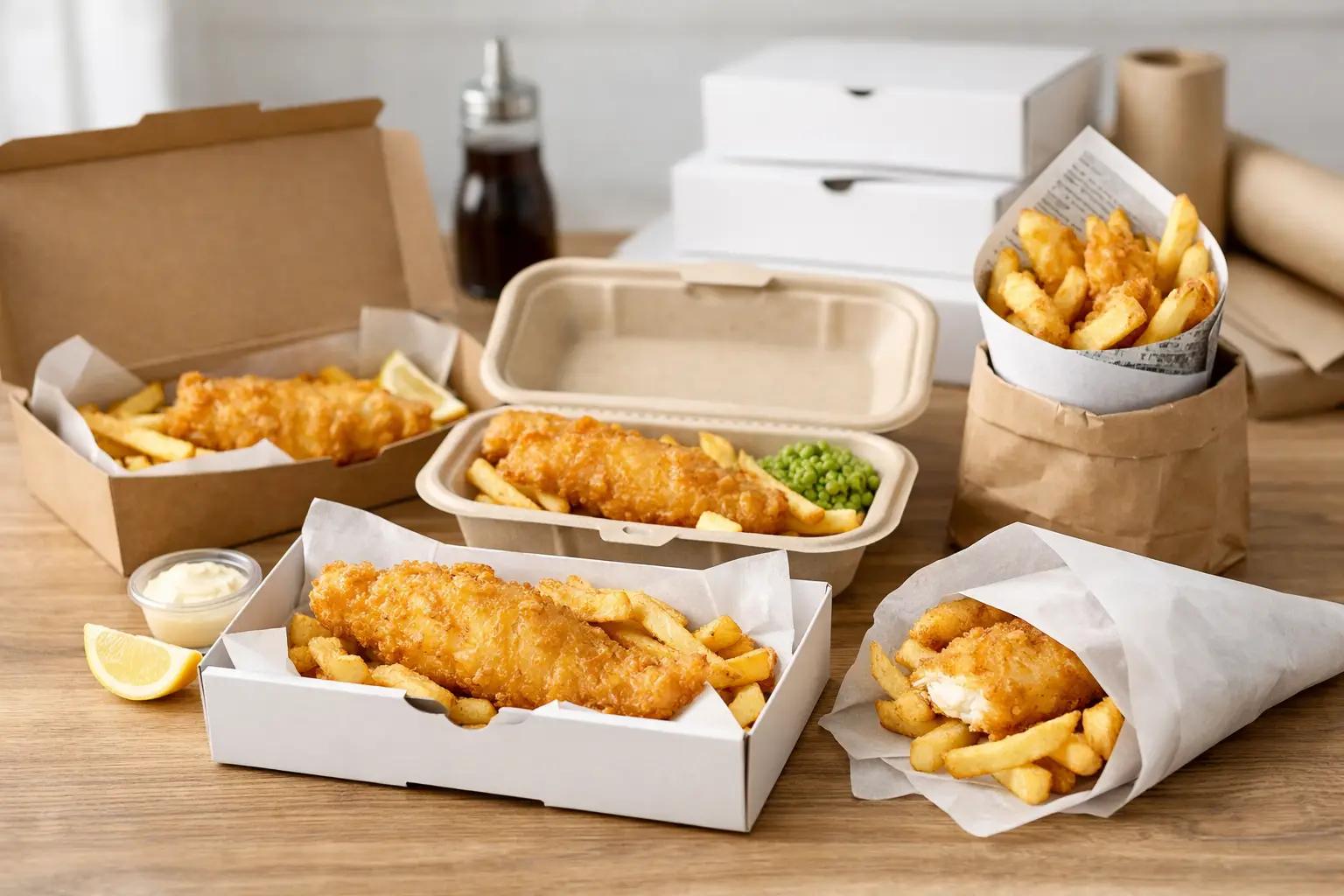
Friday night service tells you very quickly whether you have the best fish and chip packaging or just the cheapest. If the batter softens before the order gets home, chips sweat through the wrap, or vinegar leaks into the bag, the food takes the blame first. In practice, packaging is doing a lot of heavy lifting for fish and chip shops, from heat retention and grease resistance to portion control and presentation.
For most operators, the right answer is not one product. It is a packaging setup that works across counter service, click and collect, and delivery. Fish, chips, sides and sauces all behave differently once they leave the fryer, so choosing packaging by price alone usually creates problems elsewhere – more complaints, more waste, and a weaker customer experience.
Fish and chips are a difficult food format because they are hot, greasy and steam-heavy. Good packaging needs to hold temperature without trapping so much moisture that crisp coatings turn soggy. That balance matters more than any one material or style.
Grease resistance is the first non-negotiable. Fish fillets, battered sausages, scraps and chips all release oil, and weak board or poor-quality paper quickly looks untidy. If the outside of the pack starts to stain, customers assume the whole order has been thrown together carelessly. Better greaseproof and food-grade board immediately improves handling and presentation.
Strength matters just as much. A fish supper is often heavier than other takeaway meals, especially when you add sauces, pies or sides. Packaging needs enough structure to carry the load without collapsing in transit. This is particularly important for delivery orders, where packs may be stacked in insulated bags and moved around several times before reaching the customer.
Ventilation is the trade-off many businesses overlook. Full sealing keeps heat in, but trapped steam damages texture. The best fish and chip packaging usually allows a little airflow, either through the pack design or through how it is assembled. That is one reason why some operators still prefer wrapping formats for certain items, while using boxes for others.
Traditional wrapping still has a place. Greaseproof paper and wrapping paper work well for fish, chips and smaller orders where speed is important and the customer is collecting locally. Wraps are efficient, familiar and cost-effective. They also allow some steam to escape, which can help preserve crispness better than a tightly closed container.
That said, wraps are not always the best choice for modern takeaway and delivery. They are less secure for larger mixed orders, and presentation can suffer if staff are rushing. For businesses serving through apps or handling longer journey times, food boxes and trays often give better consistency.
Chip boxes are a strong option for portion control and fast service. They are easy to fill, easy to stack and straightforward for customers to carry. For shops offering regular, large and family portions, using clearly sized boxes helps standardise serving and reduce overfill. That protects margin as well as presentation.
Food trays are useful for plated-style takeaway service, especially where fish and chips are served together with sides. They offer structure without fully enclosing the food. The downside is that they usually need an additional wrap or bag for transport, so they are not always the most efficient option for delivery-heavy operations.
Clamshell-style boxes can work well for premium presentation, but they need careful selection. If the board is too light or the closure too tight, they can trap steam and compromise the batter. If you use this format, it is worth testing it with your actual menu rather than relying on a generic food box specification.
Even when boxes do most of the work, greaseproof paper remains one of the most useful items in a fish and chip shop. It acts as a liner, improves presentation and adds a layer of grease resistance where it is needed most. It can also help separate components inside a pack, reducing direct contact between hot fried items and the outer board.
There is also a branding advantage. Printed greaseproof paper turns standard takeaway packaging into something more recognisable without needing every item in the order to be bespoke. For independent shops and growing groups alike, that is a practical way to improve appearance while keeping core packaging formats simple.
This is especially relevant for operators who want a more polished takeaway offer but still need to buy in volume. Bespoke printed paper can give a branded finish across fish boxes, trays and wraps without overcomplicating stockholding.
A good fish box in a poor carrier bag is still a poor handover. Carrier bags need to support weight, contain any minor leaks and make the order easy to transport. If the bag tears, tilts or becomes greasy around the base, the whole packaging system has failed at the last step.
For lighter orders, standard takeaway bags may be enough. For larger family meals or multi-item orders, stronger paper carrier bags with reliable handles are usually a better fit. The right bag size also matters. Oversized bags allow boxes to slide around, while undersized bags create pressure points and crush the packaging.
Operators handling delivery should think about bag compatibility with the packs inside. A neatly packed order is faster to check, easier for staff to hand over and less likely to arrive in poor condition. That saves time during peak service and reduces avoidable remakes.
Not every fish and chip shop needs the same setup. A counter-led high street shop with fast local footfall will often prioritise speed, low unit cost and simple wraps. A business doing strong delivery volume may need sturdier boxes, secure sauce pots and heavier carrier bags. A seafront operation serving premium fish portions might care more about presentation and branding.
The best approach is to match packaging to how customers actually buy from you. If most orders are eaten within five minutes, ventilation may matter more than full closure. If customers travel further, stronger board and better containment become more important. If your menu includes a broad mix of fish, pies, chicken, burgers and sides, your packaging range needs enough flexibility to cover different food formats without creating unnecessary stock lines.
That is where working with a broad supplier can make purchasing easier. Instead of sourcing fish boxes from one place, greaseproof from another and bags elsewhere, many operators prefer a one-stop packaging setup that keeps ordering simpler and stock more consistent.
Every buyer looks at unit price, and rightly so. Packaging is a repeat operational cost, so small differences add up over time. But the cheapest option is not always the lowest-cost option once service issues are factored in.
If a lower-grade box softens too quickly, you may need to double-pack. If paper tears under heat and grease, staff use more sheets per order. If packaging affects food quality, repeat custom suffers. These are not abstract concerns. In takeaway, the packaging is part of the product the customer judges.
A better way to assess value is to look at portion fit, packing speed, durability and consistency alongside price. Packaging that is slightly more expensive but faster to use and more reliable in transit often works out better across a full trading week.
For many businesses, the most effective setup is fairly straightforward: a dependable chip box range in key portion sizes, greaseproof paper for wrapping and lining, sturdy food trays or boxes for larger meals, sauce pots with secure lids, and strong takeaway carrier bags. That gives enough flexibility for day-to-day service without creating an overcomplicated ordering list.
If branding is part of your growth plan, printed greaseproof paper is often the simplest place to start. It lifts presentation, works across multiple packaging formats and helps customers remember where the meal came from. For operators already investing in presentation, personalised cups and other front-of-house items can create a more joined-up brand image across the wider menu.
Grab & Go Packaging Ltd supplies the everyday packaging categories many takeaway businesses need in one place, which is useful when you want to keep ordering efficient rather than juggling multiple trade accounts.
There is no single winner for every shop. The best fish and chip packaging is the combination that protects food quality, suits your service style, supports your margins and keeps the order looking presentable from fryer to customer. A small change in box style, paper quality or bag strength can make a noticeable difference to how your food travels.
If you are reviewing your packaging, test it during real service conditions, not just on the counter. Pack a live order, hold it for the usual journey time and see how it performs. The right packaging should make your service easier, not give you another problem to manage.