
24Hr Next Day Nationwide UK delivery ( t&c`s apply )
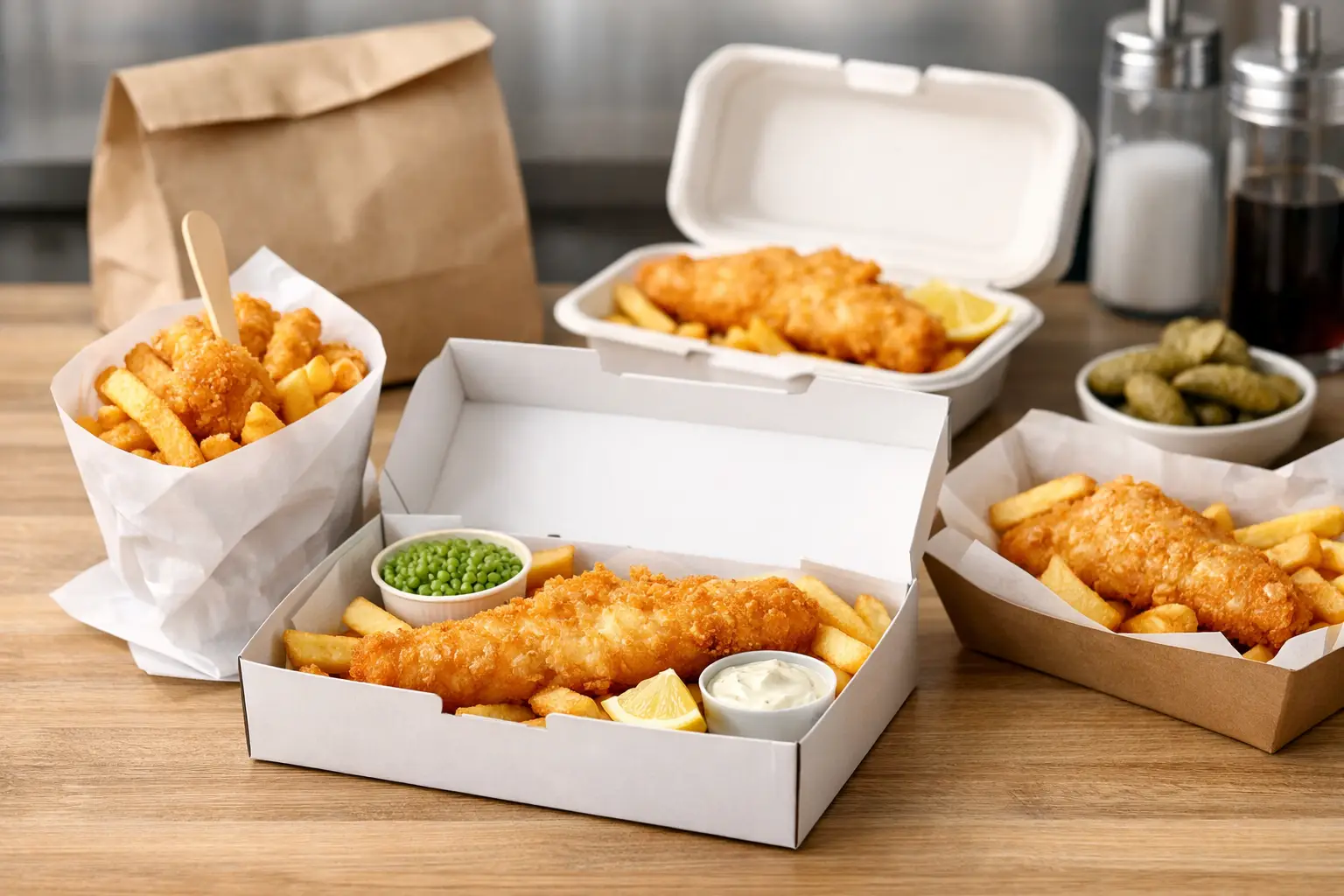
Friday tea-time rush tells you everything you need to know about packaging. If your fish and chip shop packaging cannot hold heat, manage steam, resist grease and keep service moving, it creates problems at the till, on delivery runs and when customers get home. Good packaging is not just a carrier for the food. It protects product quality, supports portion control and helps your shop look consistent on every order.
Fish and chips are simple to sell and surprisingly demanding to pack. You are dealing with heat, moisture, oil, salt, vinegar, sauces and often a short wait between frying and collection. Packaging has to handle all of that without collapsing, leaking or turning a crisp batter soft faster than it should.
That means the right format usually does several jobs at once. It needs enough structure to hold a generous portion, enough grease resistance to protect hands and bags, and enough ventilation or breathable wrapping to avoid trapping too much steam. There is always a balance here. Too much airflow and food loses heat. Too little and the chips sweat.
For most operators, the best setup is not one item but a combination. A tray or box handles the portion, greaseproof paper adds a barrier and presentation layer, and a carrier bag finishes the order for takeaway or delivery. The best results come from treating packaging as a system rather than buying each item in isolation.
Traditional service still has a place, but customer expectations have changed. Collection, click and collect, and delivery all ask more from packaging than a quick wrap over the counter.
Boxes and trays are the backbone of modern fish and chip service. They give shape to the meal, make stacking easier during busy periods and help staff serve consistent portions. They are especially useful for regular cod and chips, pie and chips, sausage meals, chicken sides and combination boxes.
The main choice is usually between a more open tray and a more enclosed box. Trays can suit food that needs a little more breathing space, while boxes can be better for carrying and keeping orders together. It depends on your menu and service model. If a high share of your trade is delivery, a sturdier enclosed pack often makes more sense. If you are mainly serving walk-in customers who eat quickly after purchase, a lighter tray may do the job well and keep cost per order tighter.
Greaseproof paper remains one of the hardest-working items in a fish and chip shop. It helps absorb excess surface grease, gives customers a cleaner handling experience and adds a familiar presentation that still fits the category. It can be used as a liner in trays and boxes or as part of a more traditional wrap.
This is also one of the most practical ways to introduce branding. Printed greaseproof paper can make a standard portion look more polished without forcing you into fully custom outer packaging across every line. For independent shops and growing groups alike, that is often a sensible middle ground between plain stock and a full bespoke range.
Carrier bags are easy to treat as an afterthought, but they affect the final handover more than most operators realise. If the bag is too small, too thin or poorly matched to your packaging dimensions, orders become awkward to pack and more likely to tip. If it is oversized, items move around and presentation suffers.
For fish and chip shops, bag choice should reflect typical order size. Single meals, family orders and mixed-item collections may each need a different format. It is worth standardising around the combinations you sell most often so staff can pack quickly without second-guessing which bag to use.
A fish and chip shop rarely sells just fish and chips. There are pies, battered sausage, chicken, fishcakes, curry sauce, gravy, mushy peas and cold drinks, often all moving through the same service window. Packaging works better when it reflects those product differences.
A large cod and chips portion needs depth and strength. Chips on their own may suit a simpler tray. Wet sides such as curry sauce and gravy need secure pots with dependable lids, especially for takeaway and delivery. Dry sides and extras can often use lighter formats. The aim is to avoid overpacking low-risk items while making sure the problem items are properly contained.
This is where buying from a supplier with broad category coverage saves time. If your trays, sauce pots, greaseproof sheets, carrier bags and cleaning essentials all come from one place, ordering becomes easier to manage and stock is more likely to stay consistent across service.
No packaging keeps fried food exactly as it was at the fryer. The question is how much quality you can protect by choosing the right materials and formats.
The biggest issue is steam. Fresh chips and battered fish release moisture immediately, and when that moisture is trapped, crispness drops. Packaging that is too tightly sealed can work against the product. On the other hand, packaging that is too open loses heat quickly, especially in colder weather or longer delivery journeys.
That is why testing matters. What works for a compact high-street takeaway may not work for a shop sending larger orders out for delivery across a wider area. Portion size matters too. A heavily loaded box behaves differently from a lighter serving. The practical approach is to test your main menu lines in real service conditions, not just on a prep bench.
For many operators, branded packaging sounds expensive until they look at where it has the most impact. Fish and chip shops do not always need every item printed. In fact, a mixed approach is often the smarter buy.
Printed greaseproof paper is one of the simplest ways to add brand recognition. It lifts presentation, works across multiple menu items and creates a more consistent look on collection and social media photos. Branded cups or selected outer packs may also make sense if you sell hot drinks, cold drinks or meal deals.
The key is to choose the items customers see most often and handle directly. That gives you the branding benefit without adding unnecessary complexity to every packaging line. For growing businesses, it is a practical route into bespoke packaging rather than an all-or-nothing decision.
Wholesale purchasing is about more than getting a lower unit price. You need pack sizes that match your turnover, storage space and ordering pattern. Buying too little means frequent reordering and the risk of running short on peak days. Buying too much ties up cash and takes up back-of-house space you may not have.
A sensible packaging range is usually built around your fastest-moving formats first. Start with the core products used on your highest-volume orders, then add supporting lines for sauces, sides and larger collections. Keep the range tight where you can. Too many overlapping sizes create confusion for staff and make stock control harder.
This is also where a one-stop supplier becomes useful. Instead of placing separate orders for trays, paper, bags, cups and cleaning supplies, you can cover daily essentials through one account. For busy shops, that matters. It saves admin time, helps standardise service items and makes repeat ordering more straightforward. Businesses looking to streamline stock purchasing can source fish and chip shop packaging and other takeaway essentials through Grab & Go Packaging at https://www.grabngopackaging.co.uk.
Cheaper packaging is not always better value. If a lower-cost tray buckles, if a lid leaks, or if a bag splits on the way out, the saving disappears quickly. Replacements, complaints and wasted food all carry a cost.
Better value usually comes from choosing the right specification for the job. Not every item needs to be premium, but every item should be fit for purpose. A straightforward chips tray may be enough for one menu line, while your flagship fish meals need a stronger format. It depends on how the item is served, how far it travels and what the customer expects when they open it.
Consistency is part of value as well. Staff work faster when packaging is familiar, easy to assemble and properly sized for the menu. That reduces packing errors and helps maintain service speed during busy periods.
If you are reassessing your packaging, start at the pass rather than in a catalogue. Look at your top-selling meals, your messiest items and your most common customer complaints. Then check whether your current packaging supports those orders properly.
A useful review normally covers three things. First, does the pack protect the food well enough for collection and delivery? Second, is it efficient for staff to use during peak service? Third, does it present the shop in the way you want customers to see it? If one of those areas is weak, the packaging is probably costing you more than it should.
The best packaging range is rarely the biggest one. It is the one that keeps service moving, keeps food presentable and gives you reliable stock lines you can reorder without fuss.
When fish and chips are your product, packaging should help the meal arrive as close as possible to how it left the fryer – hot, tidy and worth coming back for.