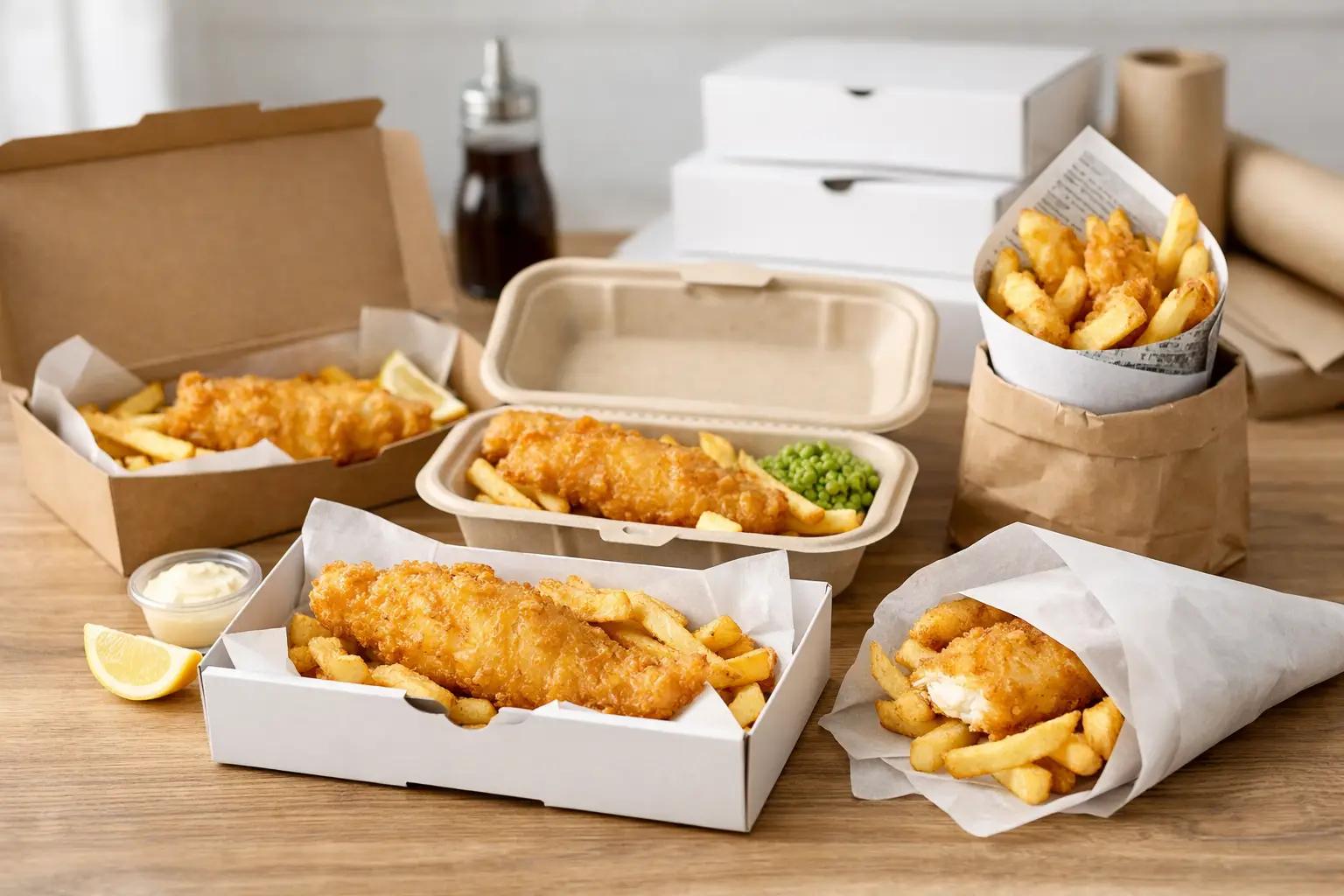
Over 500 million portions of fish and chips are sold each year in the UK, making packaging choices more important than ever for food businesses. The right box does more than just hold your meal. It protects freshness, controls grease, and helps shape the dining experience customers remember. From ensuring food safety to supporting sustainability goals, quality fish and chips packaging matters for both taste and reputation.
Table of Contents
- Defining Fish and Chips Box Packaging
- Types and Materials of Fish and Chips Boxes
- Essential Features and Performance Requirements
- Food Hygiene and UK Regulation Compliance
- Cost Analysis and Sustainable Alternatives
Key Takeaways
| Point | Details |
|---|---|
| Packaging Importance | Selecting appropriate fish and chips box packaging is essential for maintaining food quality and enhancing customer satisfaction. |
| Material Considerations | Businesses should prioritize materials that offer grease resistance, structural integrity, and eco-friendliness in their packaging choices. |
| Compliance Requirements | Adhering to UK food safety regulations is critical for ensuring packaging safety and maintaining consumer trust. |
| Sustainability Focus | Investing in sustainable packaging can lead to long-term cost savings and improve brand perception among environmentally conscious consumers. |
Defining Fish and Chips Box Packaging
Fish and chips box packaging represents a specialised food containment solution designed specifically for transporting and serving the classic British takeaway meal. According to colbeck, these boxes come in various sizes and materials tailored to accommodate different serving portions and customer needs.
Typically, fish and chips boxes are constructed from grease-resistant materials like cardboard or paperboard, which provide essential protection against oil and moisture from hot food. The packaging design usually features:
- Sturdy construction to prevent leakage
- Ventilation holes to prevent condensation
- Convenient handle or fold-over design for easy carrying
- Size variations to match portion requirements
For businesses in the food service industry, selecting the right fish and chips box is crucial. Large Printed Fish & Chips Box options can help elevate brand presentation while ensuring practical food transportation. These containers are not just about containment but also about creating a complete dining experience that reflects the quality of the food inside.
From small takeaway portions to larger family-sized servings, the fish and chips box has evolved to meet diverse consumer needs. Understanding the nuanced requirements of packaging helps food service businesses choose solutions that maintain food quality, enhance customer satisfaction, and potentially reduce packaging waste.
Types and Materials of Fish and Chips Boxes
Fish and chips boxes come in a diverse range of types and materials, each designed to meet specific food service requirements. Cardboard boxes remain the most common packaging solution, offering an ideal balance between affordability, durability, and environmental considerations.
The primary materials used in fish and chips box manufacturing include:
- Kraft Paperboard: Sturdy and grease-resistant
- Recycled Cardboard: Environmentally friendly option
- Coated Paperboard: Enhanced moisture protection
- Biodegradable Materials: Sustainable packaging alternative
For businesses looking to enhance their packaging, Small Printed Fish & Chips Box options provide an excellent opportunity to combine functionality with branding. These boxes typically come in multiple size variations to accommodate different portion sizes and customer preferences.
When selecting fish and chips packaging, food service businesses must consider several critical factors. The material should provide robust grease resistance, maintain food temperature, and offer structural integrity during transportation. Additionally, modern packaging solutions increasingly prioritise sustainability, with many manufacturers developing eco-friendly alternatives that reduce environmental impact without compromising on performance or food safety.

Essential Features and Performance Requirements
Fish and chips boxes must meet rigorous performance standards to ensure food quality, safety, and customer satisfaction. Performance requirements go far beyond simple containment, encompassing critical aspects like thermal retention, structural integrity, and grease resistance.
Key performance criteria for fish and chips packaging include:
- Grease resistance to prevent soggy packaging
- Thermal insulation to maintain food temperature
- Structural strength to support heavy food portions
- Adequate ventilation to prevent condensation
- Food-safe material certification
The Medium Plain Brown Fish & Chips Box represents an excellent example of packaging designed to meet these demanding specifications. Food service businesses must carefully evaluate packaging that can withstand the unique challenges of hot, oil-laden foods while maintaining aesthetic appeal and functional reliability.
Beyond basic performance, modern fish and chips boxes are engineered to address multiple customer and operational needs. This includes considerations like portion sizing, ease of handling, stackability for storage, and potential branding opportunities. The ideal packaging solution balances technical performance with environmental sustainability, providing a comprehensive solution that meets both operational efficiency and emerging consumer expectations for responsible packaging design.

Food Hygiene and UK Regulation Compliance
Food packaging for fish and chips must adhere to stringent food safety regulations in the United Kingdom, with comprehensive guidelines established by regulatory bodies. According to food.gov.uk, businesses must ensure that all packaging materials directly interacting with food meet strict safety standards designed to protect consumer health.
Key compliance requirements for fish and chips packaging include:
- Materials must be food-safe and non-toxic
- No chemical migration into food permitted
- Packaging must withstand intended temperature ranges
- Traceability of packaging materials
- Compliance with environmental sustainability standards
Moreover, gov.uk outlines critical producer responsibilities that extend beyond immediate food safety. These regulations mandate businesses to consider the entire lifecycle of packaging, including waste management, recycling potential, and environmental impact. The Essential Guide to Packaging in Takeaway Operations provides additional insights into navigating these complex regulatory landscapes.
For food service businesses, understanding and implementing these regulations is not just a legal requirement but a fundamental aspect of maintaining customer trust. The evolving regulatory environment demands continuous adaptation, with increasing emphasis on sustainable materials, reduced environmental footprint, and transparent supply chain practices. Businesses must remain proactive in their approach to packaging compliance, regularly updating their knowledge and systems to meet the latest food hygiene and environmental standards.
Cost Analysis and Sustainable Alternatives
Navigating the economic landscape of fish and chips packaging requires a strategic approach that balances cost-effectiveness with environmental responsibility. Sustainable packaging has emerged as a critical consideration for food service businesses, driving innovation in materials and design that can potentially reduce long-term operational expenses.
Cost considerations for fish and chips packaging typically include:
- Initial material purchase price
- Waste disposal expenses
- Potential environmental compliance costs
- Brand perception and customer loyalty impact
- Long-term sustainability investment
The Large Plain Brown Fish & Chips Box represents an excellent example of balancing affordability with sustainable design. Businesses can achieve cost optimization by selecting packaging solutions that offer multiple benefits: reduced material consumption, improved recyclability, and enhanced brand image.
Modern fish and chips packaging strategies increasingly prioritize circular economy principles, where packaging materials are designed for multiple use cycles or complete biodegradation. This approach not only addresses environmental concerns but can also provide competitive advantages by appealing to environmentally conscious consumers. Forward-thinking businesses recognize that sustainable packaging is no longer a premium option but a fundamental expectation, potentially delivering long-term cost savings through reduced waste management expenses and improved customer perception.
Elevate Your Fish and Chips Packaging Experience Today
Finding the perfect fish and chips box that balances grease resistance, thermal retention and environmental responsibility can be a real challenge for your food business. You want packaging that protects your food, showcases your brand and meets UK food hygiene regulations without compromising on sustainability or driving up costs. After exploring all the essential features and materials, it is clear that investing in the right packaging solution is key to boosting customer satisfaction and operational efficiency.
Explore our wide range of Large Printed Fish & Chips Boxes and Small Printed Fish & Chips Boxes designed specifically to meet these demands. 
Don’t wait until packaging issues affect your takeaway service. Visit Grabngo Packaging now to find fish and chips boxes that combine durability, style and compliance for your business. Act now to secure reliable packaging solutions that protect your food and reinforce your brand identity with every order.
Frequently Asked Questions
What materials are commonly used for fish and chips box packaging?
Fish and chips boxes are typically made from materials like Kraft paperboard, recycled cardboard, coated paperboard, and biodegradable materials, providing a balance between durability, grease resistance, and environmental considerations.
What are the essential features to look for in fish and chips boxes?
Key features include grease resistance, thermal insulation for maintaining food temperature, structural integrity to support heavy portions, adequate ventilation to prevent condensation, and food-safe material certification.
How important is food hygiene compliance for fish and chips packaging?
Food hygiene compliance is crucial as packaging must adhere to safety standards to prevent chemical migration into food, ensure materials are non-toxic, and withstand intended temperature ranges, thereby protecting consumer health.
How can businesses optimize costs while using fish and chips boxes?
Businesses can optimize costs by choosing packaging that minimizes material consumption, improves recyclability, enhances brand perception, and considers long-term sustainability investments, potentially reducing waste disposal expenses.